ICBC GLP Changes 2026: What N Drivers Need to Know
On October 19, 2026, ICBC changes how many BC Class 7N drivers move toward a Class 5 licence. For eligible drivers, the second road test is replaced by a Driving Record Assessment.
That does not make driving skill less important. It makes everyday habits, your driving record, and clear lesson feedback more important.
October 19, 2026
Eligible Class 7N drivers move forward through a Driving Record Assessment instead of the second road test.
Restriction 55
Class 5 with zero blood alcohol and zero blood drug content while driving for 12 months.
Skills that still matter
Mirror checks, shoulder checks, safe spacing, speed control, turns, lane position, parking, and calm choices in traffic.
What is actually changing?
ICBC says drivers with a clean Class 7 novice record will not take a second road test to get a Class 5 licence with restrictions after October 19, 2026. The new step is the Driving Record Assessment.
For the assessment, ICBC is looking at the record you built while driving independently. The key items are no prohibitions or suspensions, no excessive speeding convictions, and no convictions for using an electronic device during the required time period.
If you qualify, you can move to a Class 5 licence with restriction 55 for 12 months. If you get a prohibition or suspension during that restriction period, ICBC says the 12 months restarts after your licence is reinstated.
Does this mean N drivers no longer need lessons?
No. It means lessons should focus on skills that transfer from one road to another, not just repeating a familiar route.
The new pathway puts more weight on real driving habits. A driver who regularly speeds, checks late, follows too closely, rolls stops, or makes poor gap choices is not safer just because there is one less test.
A good lesson should tell you what your driving actually looks like: which habits are safe, which habits are inconsistent, and which patterns would show up on a marking sheet or in everyday risk.
Who qualifies for the Driving Record Assessment?
If you are under 25, ICBC says you need 24 months of safe driving, or 18 months if you completed an approved GLP course during the learner phase.
If you are 25 or older, ICBC says you need 12 months of safe driving with a Class 7 licence.
In both age groups, ICBC says the record must be clear of prohibitions, suspensions, excessive speeding convictions, and electronic-device-use convictions during the required period.
What if you already have your N?
ICBC says eligible drivers may receive a letter about a one-time automatic upgrade on October 19, 2026. You still need to remain eligible up to that date.
ICBC public information says prohibitions, suspensions, excessive speeding, electronic-device convictions, outstanding debt, licence expiry, or certain holds can affect eligibility.
If you had a Class 5 exit road test booked for October 19, 2026 or later, ICBC says it will be cancelled and ICBC will email you about next steps.
The marking sheet is changing too
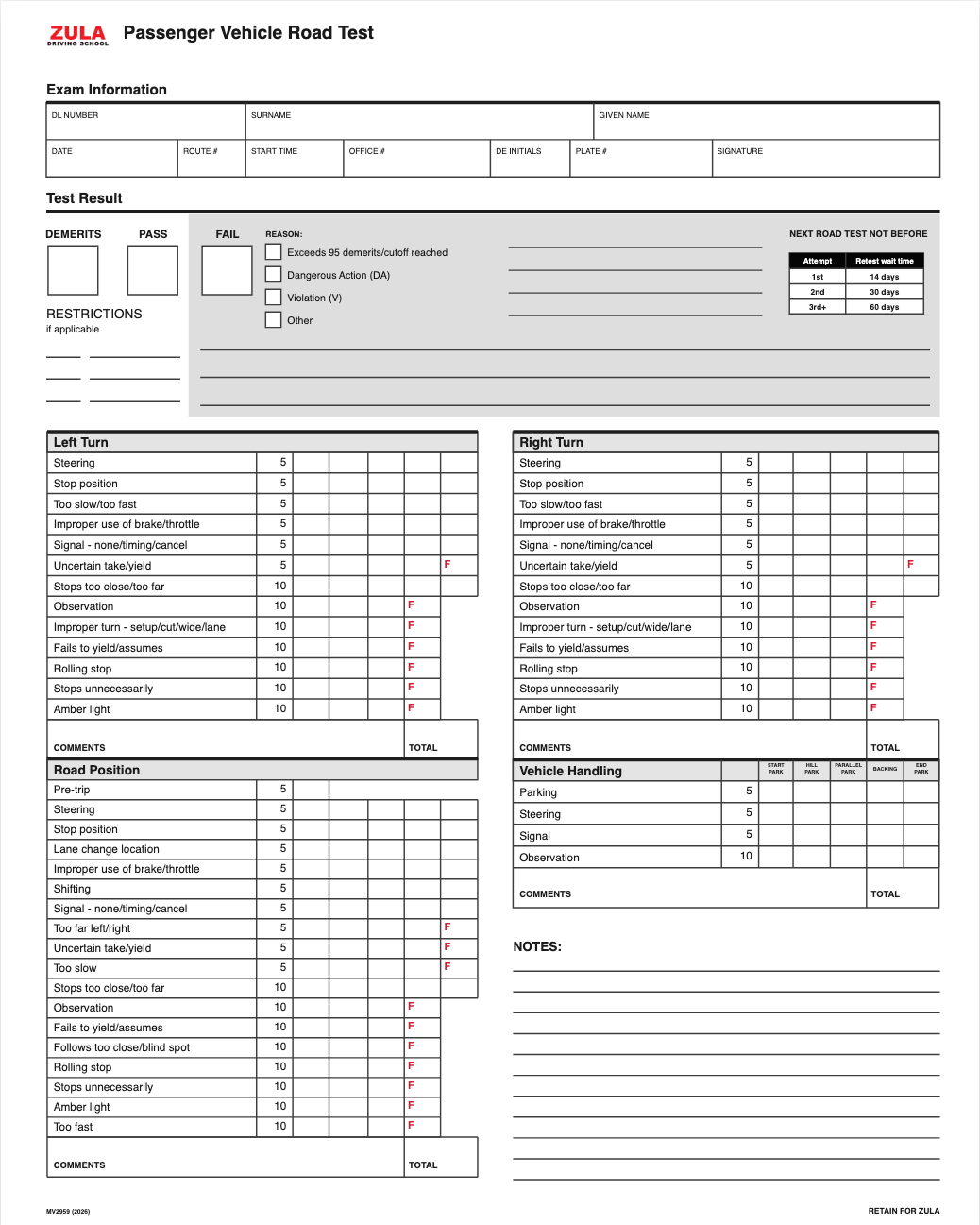
The new passenger-vehicle marking sheet gives students a clearer breakdown than the older summary-style result. It organizes feedback into left turns, right turns, road position, and vehicle handling.
Marks are worth 5 or 10 demerits. The limit is 95 demerits, so 100 demerits is a fail. Some repeated behaviours also have an error cutoff, shown with red F positions on the sheet.
Dangerous actions, violations, and other disqualification reasons still matter separately from the demerit total. ICBC also says the appointment includes more debrief time, while the driving portion itself is not meant to become longer.
What should a lesson focus on now?
Turns
Steering path, stop position, speed into the turn, brake and throttle control, signalling, take/yield judgment, rolling stops, and unnecessary stops.
Road position
Lane-change location, lane position, blind spots, following distance, stop spacing, speed choice, and room around parked vehicles.
Vehicle handling
Start park, hill park, parallel park, backing, end park, and whether the vehicle is controlled calmly enough for real traffic.
What this means for your lessons
Zula Driving School already gives students detailed lesson feedback, including instructor notes, skill ratings, ICBC focus areas, readiness scoring, and clear next steps. That quality of feedback is not changing.
What is improving is the visual layout of how students see that feedback. The updated lesson report is being designed to align more closely with the new ICBC road test marking sheet, so students become more familiar with road-test expectations throughout their learning journey.
That means the same coaching can be easier to connect to test-day categories like turns, road position, vehicle handling, observation, spacing, speed choice, and decision-making.
The purpose is to keep the coaching depth students already get while making each lesson report clearer, more familiar, and easier to act on before they drive more independently.
For exact dates, fees, and eligibility
Use ICBC public pages for the final word on eligibility, fees, dates, restrictions, appointments, and licence status. Zula Driving School can help you understand what the changes mean for your training and what to practise before your next lesson or road test.
Get feedback you can actually use
Book a focused driving lesson in North Vancouver and get clearer feedback on the habits that matter before a test, after a failed test, or before more independent driving.